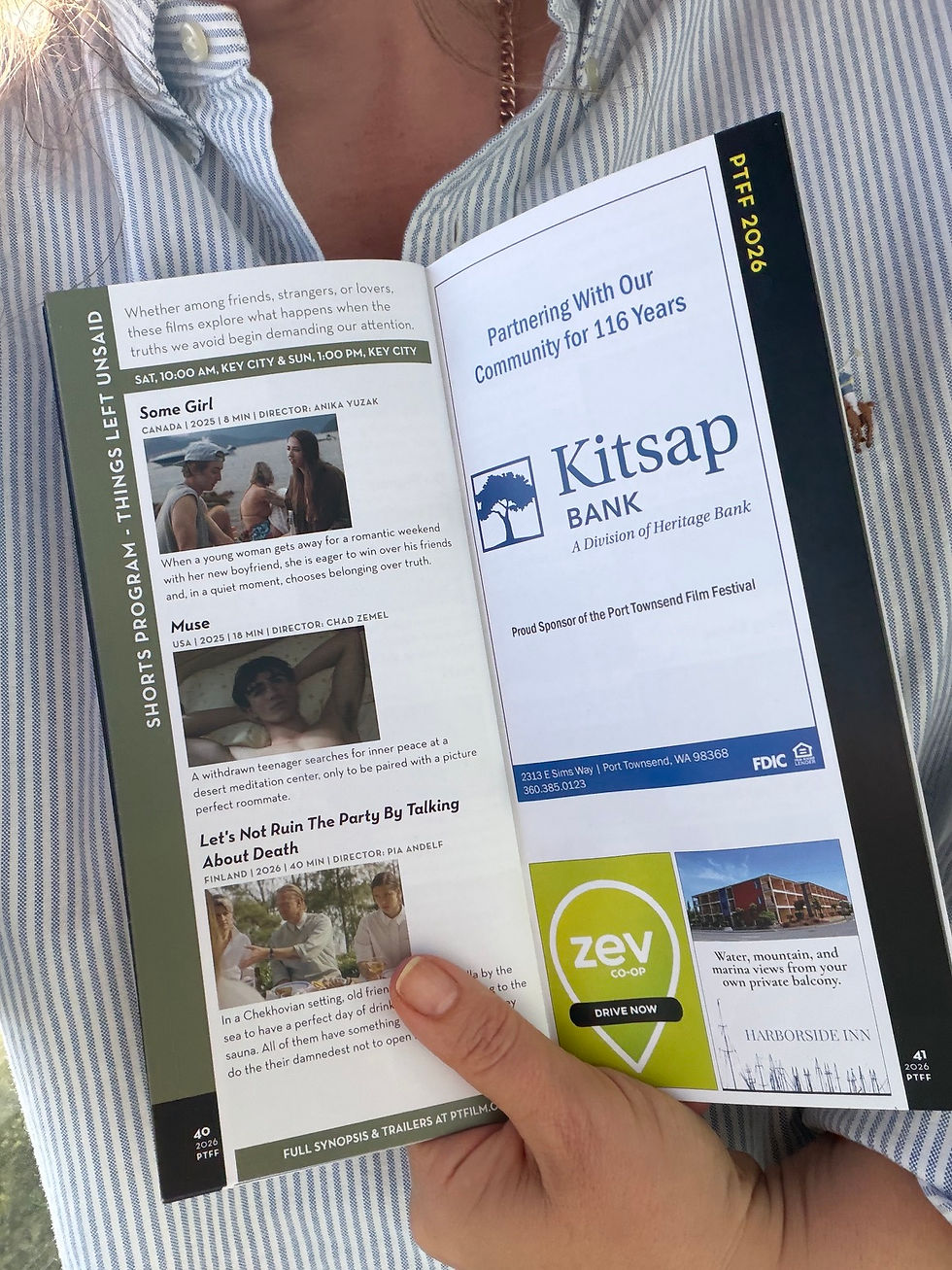
Before leaving Vancouver, I tie up all my loose ends, and as I speed past the Bigfoot museums and small-town attractions toward the Port Townsend Film Festival, I realize how tired I am. Part of me wonders why I go to all this trouble of trying to make movies at all. Still, another part of me has been dreaming of this moment: showing my short film, Some Girl, on the festival circuit.
Before dusk, I check into my dusty waterfront motel. It’s a little depressing. I wonder if I should have treated myself to something more luxurious.
I decide to walk the 30 minutes into town to see a satire about school shootings, Run Amok. I tuck myself into the back of the theatre, and before long I’m laugh-crying. The film explores the fallout of violence and the path to healing. I leave uplifted.
As I head back to my hotel, I notice a group of young filmmakers from LA. Stylish and fast-talking, self-possessed and confident. I can see in them what I see in myself: the striving, the desire to be seen, the performance of being a filmmaker.
The next morning, I attend my own screening. My film is paired with a beautiful Finnish film about mortality called Don’t Ruin the Dinner Party by Talking About Death. Pia Andel, the Finnish filmmaker, is peaceful, sophisticated, well-spoken and kind. Everyone in her films has real bodies. I’m in good company.
I befriend her at the after-party. I ask if she wants her film to reach a broader audience, and she shrugs. She says she still has a couple of films in her. She’s 61.
The young LA filmmakers are there too, and before long we all move to another bar across the street. We talk about dating in LA, which turns out to be exactly like dating in Vancouver. Everyone wants love, but we’re suspicious of marriage, and the seemingly endless catalogue of people on dating apps doesn’t help.
The next day, at the second screening of my film, I’m more comfortable. Pia is a friend now. It’s a small, intimate audience this time, and there’s lots to talk about. Women share how much they relate to the film. Someone says they’d like to see it shown in schools to start a conversation with young men. I hadn't imagined that possibility. This must be why I'm trying to make movies.
Then I’m back on the road. When I get back to my apartment, I scroll for a bit without unpacking. I happen on a clip of Jessica Lange talking about existential sadness. She says her sadness has informed her acting and photography. I think I feel the same way. And it’s nice to be home in my own bed.
I’ve been working as a cast assistant for the last few months, and somewhere between sourcing trailers and snacks and delivering scripts, I’ve been chipping away at my screenplay.
I pitched the concept to a producer recently. She wants to read it.
There’s something intoxicating about the movie business—the sense that anything can happen at any moment. A conversation, a glance, a favour, and suddenly your life tilts in a new direction. It has a kind of circus energy. I enjoy the controlled chaos, the intensity. After a while, you start to see what it asks of people.
The stars spend their days exhausting themselves being wonderful. I don’t blame them for being tired. The flip side of being so wanted is… being so wanted. Some of them are so famous their assistants have assistants, and their fluffers have fluffers.
(A fluffer, I learned, is a term for someone who organizes discreet sexual encounters in exchange for the possibility of an associate producer credit.)
And days on a film set can be absurd. But in the middle of it—something in me has settled.
Not because I’ve arrived. Not because I’ve made it.
But because I want to be here. And I like the work.
There’s a kind of comfort, too, in being part of a temporary family—producers and production assistants, talented technicians, icons, breakout stars, executive producers, stand-ins, cooks, nepo babies—the power, the care, the laughter, the prestige, the failures, the entitlement, the ego…
I wonder if underneath it all, we’re just people trying to have an experience.
We’ve decided this matters to us.
And so it does.
Lately, that’s included finishing my own film.
Some Girl is playing this weekend at the Portland Panorama Film Festival.
If you’re in the area, I’d love to see you.

This was the summer of meeting up at the beach to talk about artificial intelligence. My good friend shakes out her towel and says she thinks she’s losing her brother to the manosphere. We decide he’s young, impressionable, and probably just looking for a way to belong.
I don’t know much about the manosphere. I assume it’s those entrepreneurs-in-cars who pop up on my feed and call me a femcel. From what I gather, it’s about men falling behind in education and earning capacity, and an existential resentment about not being able to give birth. I can relate to the latter. It’s a strange feeling to put a full stop on millions of years of ancestral evolution.
But it’s hard to reconcile the mean-spirited online personas with the men I know in real life, who are so often gentle, thoughtful, and kind.
Maybe this is the backlash against feminism we were warned about, which would explain why I’ve been working through my neglected stack of feminist theory. I like the idea that feminism returns as needed.
Lately, I’ve been reading Germaine Greer’s The Female Eunuch, her 1970 exploration of how women’s limited perceptions of ourselves shape our lives.
I especially liked the chapter on romance, where she describes how romantic stories soothe women — how they offer escape from the drudgery of unpaid emotional and domestic labour. Greer writes that romantic storytelling flourished among bored homemakers alongside the invention of the printing press.
She says men don’t understand how deeply entrenched women are in romantic fantasy. But I think the womanizers probably do. And the drearier my schedule, the more susceptible I become to wishful thinking — romance becomes a kind of escape hatch: a fantasy of being chosen, seen, swept away.
On the drive home from the beach, windows down and music up, I wonder if the answer isn’t to shut the door on romance completely, but to meet it with open eyes. After all, the romantic brain is millions of years old, older than language itself, wired to light up at the possibility of connection.
And maybe there’s a romance, too, in becoming.
In knowing ourselves better.
In trusting our bodies.
In expressing our creativity.
In living beyond the need to be saved.
What the TikTokers might call “main character energy.”
The sun is warm on my face, the wind in my hair, the sand from the afternoon still between my toes. For now, I’m finally content in the quiet romance of my own life.
